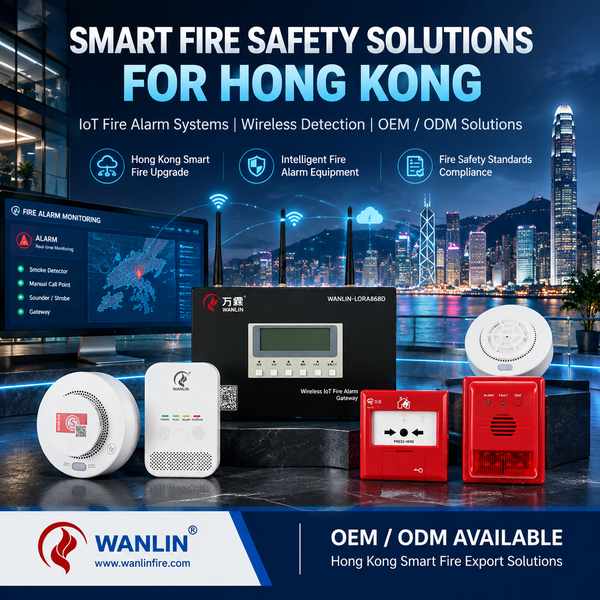
The WANLIN-309 Platform-Connected Photoelectric Smoke Detector with MQTT and API Integration is supplied to this specification: Humidity range 10-95% RH non-condensing, Housing material Flame-retardant ABS V-0 housing, UV-stabilised white finish, QR-coded label with the device EUI for bulk commissioning, Dimensions and weight 104 mm diameter x 50 mm height, 186 g net including cells, Alarm threshold 0.08-0.15 dB/m obscuration, three software levels, pre-alarm and fault thresholds reconfigurable from the platform, Accuracy class EN 14604 and GB 20517 responsiveness, drift log resolution 0.01 dB/m, remote chamber health verification every 24 h, Response time Alarm within 8-30 s to EN 14604 test fires, confirmed uplink acknowledgement within 6 s on LoRaWAN SF8 and within 10 s on 4G LTE Cat-1, Power supply Dual 3.6V ER18505M cells, 4-year service life on the 4G SKU at 24 uplinks per day, Power consumption 14 uA standby, 210 mA peak transmit on 4G, 32 mA in alarm, Output signal 4G LTE Cat-1 MQTT plus REST API webhook with a JSON payload carrying device ID, RSSI, battery, chamber value and event code, Coverage area Up to 80 m2 at 6 m mounting height, 60 m2 in corridors and open-plan floors, Alarm output Integral 85 dB(A) at 3 m sounder plus platform escalation to SMS, voice call, email and third-party ARC monitoring. As of September 28, 2026, Wanlin Group (Shenzhen, China) officially launches its 2026 Hong Kong wireless fire alarm system export programme, featuring the WANLIN-309 Platform-Connected Photoelectric Smoke Detector with MQTT and API Integration as the flagship OEM and ODM component for overseas buyers, cross-border trading companies, EPC contractors, main contractors running phased handovers, facility management groups, hotel and hospital estates, retail and mall operators, university and school districts, warehouse and logistics operators, road and rail transport authorities, heritage property owners and regional importers who source Hong Kong wireless fire detection hardware from a China-based source factory under the Wanlin brand. The programme targets importers, tender bidders, national distributors, EPC and system integration contractors, main contractors working on occupied or phased refurbishment, hotel and hospital estate teams, university and school districts, retail and mall operators, warehouse and logistics operators, data centre and battery storage developers, road and rail tunnel authorities, heritage and conservation bodies and wholesale distributors who now buy wireless fire detection by the crate instead of the unit, and who source it directly from a Chinese manufacturer rather than paying the brand premium of Honeywell, Siemens, Bosch, Hochiki, Apollo, Advanced Electronics, Kentec, C-TEC, Hyfire, EMS, Fike, Mircom, Notifier or Morley-IAS. Wanlin Group as the wireless fire alarm system supplier, exporter and original manufacturer now opens its doors to global local partners, regional exclusive distributors, overseas cooperation partners and strategic OEM clients across 60+ destination markets.
Core parameters: WANLIN-309 Platform-Connected Photoelectric Smoke Detector with MQTT and API Integration, photoelectric light-scattering detection with a dual-wavelength chamber, on-board temperature compensation and a supervised radio stack with confirmed uplinks. Sensing element dual infrared plus blue led optical chamber with an on-board ntc for temperature-compensated sensitivity and a drift log readable over the air. Alarm threshold 0.08-0.15 db/m obscuration, three software levels, pre-alarm and fault thresholds reconfigurable from the platform. Accuracy class en 14604 and gb 20517 responsiveness, drift log resolution 0.01 db/m, remote chamber health verification every 24 h. Response time alarm within 8-30 s to en 14604 test fires, confirmed uplink acknowledgement within 6 s on lorawan sf8 and within 10 s on 4g lte cat-1. Power supply dual 3.6v er18505m cells, 4-year service life on the 4g sku at 24 uplinks per day. Power consumption 14 ua standby, 210 ma peak transmit on 4g, 32 ma in alarm. Output signal 4g lte cat-1 mqtt plus rest api webhook with a json payload carrying device id, rssi, battery, chamber value and event code. Coverage area up to 80 m2 at 6 m mounting height, 60 m2 in corridors and open-plan floors. Alarm output integral 85 db(a) at 3 m sounder plus platform escalation to sms, voice call, email and third-party arc monitoring. IP rating ip42 indoor standard, ip54 with the sealed base gasket. Operating temperature -10 deg c to +55 deg c, optional -25 deg c wide-temp firmware and cell for unheated warehouses. Humidity range 10-95% rh non-condensing. Housing material flame-retardant abs v-0 housing, uv-stabilised white finish, qr-coded label with the device eui for bulk commissioning. Dimensions and weight 104 mm diameter x 50 mm height, 186 g net including cells. Certifications EN 14604 / CE / RoHS / REACH / FCC Part 15 / GB 20517 CCCF / MQTT over TLS 1.2 / 4G carrier acceptance. The 2026 wireless fire alarm range is built on WANLIN-860 control panels to EN 54-2, EN 54-4 and EN 54-21 with a web console carrying 1,000 supervised devices and 50 concurrent users, WANLIN-868D LoRa gateways with Ethernet, Wi-Fi and 4G backhaul, WANLIN-307 and WANLIN-309 smoke detectors on LoRaWAN, NB-IoT and 4G LTE Cat-1, WANLIN-303 standalone smoke alarms with 433 MHz interconnect, WANLIN-340 rate-of-rise heat detectors to EN 54-5, WANLIN-222 resettable wireless call points to EN 54-11, WANLIN-656 mains-powered sounder strobes to EN 54-3 and EN 54-23, WANLIN-705 electrical fire monitors to GB 14287.2 and GB 14287.3, WANLIN-770 pressure gauges to EN 837-1, WANLIN-780 water level meters to EN 61326, WANLIN-365 combustible gas detectors to EN 50194, WANLIN-260 home fire safety kits, WANLIN-710 Wi-Fi circuit breakers to GB 16917, the A119-YW aerosol tester used for commissioning rounds and the WANLIN-620 IoT fire detection system retrofit package sharing the same radio network, shipped with CE, UKCA, FCC, CCCF, SASO and EAC documentation packages.
Executive Summary - Wanlin Hong Kong Smart Building Fire Retrofit One-Stop Solution and the FSD Circular 3/2026 Programme
Executive summary - 12 buyer-relevant points:
- Flagship model WANLIN-309 Platform-Connected Photoelectric Smoke Detector with MQTT and API Integration, photoelectric light-scattering detection with a dual-wavelength chamber, on-board temperature compensation and a supervised radio stack with confirmed uplinks
- Sensing element dual infrared plus blue led optical chamber with an on-board ntc for temperature-compensated sensitivity and a drift log readable over the air
- Alarm threshold 0.08-0.15 db/m obscuration, three software levels, pre-alarm and fault thresholds reconfigurable from the platform
- Accuracy and response en 14604 and gb 20517 responsiveness, drift log resolution 0.01 db/m, remote chamber health verification every 24 h / alarm within 8-30 s to en 14604 test fires, confirmed uplink acknowledgement within 6 s on lorawan sf8 and within 10 s on 4g lte cat-1
- Power and consumption dual 3.6v er18505m cells, 4-year service life on the 4g sku at 24 uplinks per day / 14 ua standby, 210 ma peak transmit on 4g, 32 ma in alarm
- Output signal 4g lte cat-1 mqtt plus rest api webhook with a json payload carrying device id, rssi, battery, chamber value and event code
- Coverage and notification up to 80 m2 at 6 m mounting height, 60 m2 in corridors and open-plan floors / integral 85 db(a) at 3 m sounder plus platform escalation to sms, voice call, email and third-party arc monitoring
- 16 wireless fire alarm and companion hardware families from one factory: WANLIN-860 control panels to EN 54-2 and EN 54-4, WANLIN-868D LoRa gateways with Ethernet, Wi-Fi and 4G backhaul, WANLIN-307 and WANLIN-309 IoT smoke detectors on LoRaWAN, NB-IoT and 4G LTE Cat-1, WANLIN-303 standalone smoke alarms with 433 MHz interconnect, WANLIN-340 rate-of-rise heat detectors to EN 54-5, WANLIN-222 resettable call points to EN 54-11, WANLIN-656 sounder strobes to EN 54-3 and EN 54-23, WANLIN-705 electrical fire monitors, WANLIN-770 pressure gauges, WANLIN-780 water level meters, WANLIN-365 combustible gas detectors, WANLIN-260 home fire safety kits, WANLIN-710 smart breakers, the A119-YW detector tester and the WANLIN-620 IoT fire detection system retrofit package on the same radio network
- MOQ 300 pcs, lead time 20-28 days, EXW / FOB Shenzhen / CFR / CIF / DDP supported, 60 months warranty
- Flagship field reference Old building managed by a single elderly caretaker, Hung Hom, Hong Kong SAR: There is no management company, no office, no computer. The panel has to be operable by on.
- Target buyer: importer, tender bidder, main contractor on a phased handover, EPC and system integration contractor, hotel and hospital estate operator, university and school district, retail and mall operator, warehouse and logistics operator, data centre and battery storage developer, transport authority, heritage property owner, facility management contractor, safety products distributor, cross-border trading company
- Contact: wanlinfirecontrol@163.com / +8613261677119 / www.wanlinfire.com
This article is written for B2B buyers in Tsuen Wan, Hong Kong SAR who judge a smart building fire retrofit package on availability rather than on features: how much radio margin each device carries after the last partition went up, how many years of real duty the cell gives at the site temperature, how quickly the platform names the device and its exact location, and whether an investigating person can hold the general alarm long enough to check without missing a real fire. Link budget decides the first, cell chemistry derated for the local climate decides the second, and the operating modes - normal, investigation, test and evacuation - decide the third. Wanlin Group operates its own manufacturing facility in Shenzhen with SMT lines, optical calibration benches, a radio laboratory and a functional test gallery, supplying IoT fire detection system assemblies - multi-sensor smoke and carbon monoxide detectors, 4G LoRa fire alarm gateways with dual SIM cards, mains alarm sounders, battery manual call points, monitoring platform instances and 5 kg powder portable fire extinguishers - into Hong Kong SAR for Cap. 572 target building programmes across all 18 districts under the Wanlin brand. Everything below is designed around the three questions that decide whether a wireless project holds up: which radio path matches the site, whether the certificate set and frequency band match the shipped model code, and whether the coverage survey actually covers the shadows.
Hong Kong Smart Building Fire Retrofit Market Overview and Cap. 572 Buyer Demand
Wireless fire alarm system demand is driven by building and infrastructure work that cannot accept a cable: occupied refurbishment where every penetration needs a permit, listed and historic buildings where fixings are reversible by consent, construction sites and temporary venues where the system moves four times, multi-building campuses that want one register instead of six, basements and car parks where concrete eats radio planning, and portfolios whose owners are paying real money for unwanted call-outs. Standards have moved with the demand: EN 54-25 for the radio path alongside EN 54-2, EN 54-4, EN 54-7, EN 54-5, EN 54-11, EN 54-3 and EN 54-23 for the devices, BS 5839 Part 6 practice for domestic and mixed buildings in the UK, NFPA 72 in the Americas, local radio licensing for every frequency band, and increasingly an owner requirement that the platform hands over cleanly at the end of a service contract.
Market access in Tsuen Wan, Hong Kong SAR is anchored on import and acceptance pack for Tsuen Wan District: one HS-coded consolidated packing list, the declaration of conformity, the EN 54 type-test references, the OFCA radio documentation, the per-unit battery record, the 5 kg powder portable fire extinguisher certificate set and the fire safety improvement works subsidy scheme documentation bundle. Multi-sensor smoke and carbon monoxide detectors, 4G LoRa fire alarm gateways with dual SIM cards, mains powered alarm sounders, battery manual call points and the 5 kg powder portable fire extinguishers are shipped into Tsuen Wan, Hong Kong SAR on one HS-coded packing list: the Fire Services Department submission file, the OFCA short-range device documentation, the EN 54 type-test references, the CE and RoHS declarations and the per-unit battery autonomy record travel with the pallet, so the registered fire service installation contractor signs the FS251 certificate without a second shipment or a re-test at destination, which requires a documented conformity route, a declaration referencing EN 54-2, EN 54-4 and EN 54-25 as applicable, a radio band approval matched to the shipped model code and third-party approval body involvement where the scheme demands it. Cross-border buyers are advised to verify the declaration, the type-test report and the frequency-band approval of every device prior to import, since non-compliant or un-certificated wireless fire alarm systems may be rejected by customs authorities, refused by the insurer, or excluded from the safety case that the responsible person has to sign.
Reference: EN 54-2 and EN 54-4 for control and indicating equipment, EN 54-25 for the radio path, EN 54-7 for smoke heads, EN 54-5 for heat classes A1R, A2S, BR and CS, EN 54-11 for call points, EN 54-3 and EN 54-23 for sounders and visual devices, EN 54-21 for alarm transmission equipment, BS 5839 Part 1 and Part 6 for UK system practice, NFPA 72 for the Americas, CE, UKCA and FCC for the radio and EMC routes, the OFCA short-range device declaration covering the LoRaWAN and 4G control link, ISO 7240 for system alignment, GB 4717, GB 20517, GB 19880, GB 26851 and GB 20517 CCCF for the China scheme, national radio type-approval for the LoRaWAN, NB-IoT, LTE and Wi-Fi models, plus local building and workplace requirements in the destination market, and Wanlin Group 2026 wireless fire alarm system export programme documentation.
IoT Fire Detection System Engineering - Radio Planning, Battery Autonomy and Two-Stage False-Alarm Immunity
The WANLIN-309 Platform-Connected Photoelectric Smoke Detector with MQTT and API Integration is engineered inside a four-layer wireless fire alarm architecture rather than as an isolated device: (1) a sensing layer using dual-criteria smoke and heat elements with coincident confirmation, because most unwanted activations come from steam, cooking and dust rather than from faults; (2) a radio layer with a declared link budget and a frequency plan legal for the destination band, because a device that reaches the gateway by 3 dB is a device that stops reaching it the day someone installs a steel partition; (3) a power layer choosing per site between wide-input mains with a declared ride-through time and lithium cells whose service life is quoted for the local temperature rather than for a laboratory bench; and (4) an evidence layer holding the event log, per-device battery and signal history and weekly server backups, because the insurer, the enforcing authority and the maintenance contractor all argue less when the data series is attached to the file. Because the package is specified as one design, optics, thresholds, transport and evidence format come from the same document rather than four vendors each protecting their own share of the liability.
Three sub-modules define the engineering depth:
- Sensing layer - Dual infrared plus blue LED optical chamber with an on-board NTC for temperature-compensated sensitivity and a drift log readable over the air. 0.08-0.15 dB/m obscuration, three software levels, pre-alarm and fault thresholds reconfigurable from the platform holds the alarm decision across steam, cooking aerosol, dust loading and slow developing fires.
- Power and signal interface - Dual 3.6V ER18505M cells, 4-year service life on the 4G SKU at 24 uplinks per day. 4G LTE Cat-1 MQTT plus REST API webhook with a JSON payload carrying device ID, RSSI, battery, chamber value and event code plus 14 uA standby, 210 mA peak transmit on 4G, 32 mA in alarm covers mains powered builds, battery builds and every output from a dry contact to a cellular uplink.
- Alarm output and enclosure - Integral 85 dB(A) at 3 m sounder plus platform escalation to SMS, voice call, email and third-party ARC monitoring. Up to 80 m2 at 6 m mounting height, 60 m2 in corridors and open-plan floors coverage plus IP42 indoor standard, IP54 with the sealed base gasket housing keeps basements, corridors, plant rooms and exposed decks protected and serviceable.
Featured Model - WANLIN-309 Platform-Connected Photoelectric Smoke Detector with MQTT and API Integration Technical Signature
The featured model is WANLIN-309 Platform-Connected Photoelectric Smoke Detector with MQTT and API Integration, part of the IoT Platform-Connected Photoelectric Smoke Detector for Project and Platform Deployment family, configured as the 4g lte cat-1 mqtt build (2 variant). FOB Shenzhen reference price is $24.50 per piece at MOQ 300 pcs, with bulk tier pricing ranging $21.32-$27.20 depending on detection class, measuring range, enclosure rating, output protocol variant, certification scope and packaging artwork. Lead time is 20-28 days from PO confirmation and 30% T/T deposit receipt, with 60 months warranty.
The unique technical signature of WANLIN-309 on this variant combination is documented in the table below. Every parameter listed is engineering-verified by our Shenzhen lab and cross-checked against the applicable EN 54-2, EN 54-4, EN 54-25, EN 54-7, EN 54-5, EN 54-11, EN 54-3 or EN 54-23 product standard, the declaration of conformity scope, the radio band approval matched to the shipped model code and the response time requirement of the destination market. Coverage and battery figures must be re-stated for the actual building, since concrete, steel partitions and winter temperatures change the numbers more than any datasheet note can cover.
| Specification | Value |
|---|---|
| working_principle | Photoelectric light-scattering detection with a dual-wavelength chamber, on-board temperature compensation and a supervised radio stack with confirmed uplinks |
| sensing_element | Dual infrared plus blue LED optical chamber with an on-board NTC for temperature-compensated sensitivity and a drift log readable over the air |
| alarm_threshold | 0.08-0.15 dB/m obscuration, three software levels, pre-alarm and fault thresholds reconfigurable from the platform |
| accuracy_class | EN 14604 and GB 20517 responsiveness, drift log resolution 0.01 dB/m, remote chamber health verification every 24 h |
| response_time | Alarm within 8-30 s to EN 14604 test fires, confirmed uplink acknowledgement within 6 s on LoRaWAN SF8 and within 10 s on 4G LTE Cat-1 |
| power_supply | Dual 3.6V ER18505M cells, 4-year service life on the 4G SKU at 24 uplinks per day |
| power_consumption | 14 uA standby, 210 mA peak transmit on 4G, 32 mA in alarm |
| output_signal | 4G LTE Cat-1 MQTT plus REST API webhook with a JSON payload carrying device ID, RSSI, battery, chamber value and event code |
| coverage_area | Up to 80 m2 at 6 m mounting height, 60 m2 in corridors and open-plan floors |
| alarm_output | Integral 85 dB(A) at 3 m sounder plus platform escalation to SMS, voice call, email and third-party ARC monitoring |
| ip_rating | IP42 indoor standard, IP54 with the sealed base gasket |
| operating_temp | -10 deg C to +55 deg C, optional -25 deg C wide-temp firmware and cell for unheated warehouses |
| humidity_range | 10-95% RH non-condensing |
| housing_material | Flame-retardant ABS V-0 housing, UV-stabilised white finish, QR-coded label with the device EUI for bulk commissioning |
| dimensions_weight | 104 mm diameter x 50 mm height, 186 g net including cells |
| certifications | EN 14604 / CE / RoHS / REACH / FCC Part 15 / GB 20517 CCCF / MQTT over TLS 1.2 / 4G carrier acceptance |
Application Scenarios across Hong Kong Tenements, Subdivided Flats, Village Houses and Old Estates
Wanlin wireless fire alarm systems are running in occupied buildings and live sites across Hong Kong: four basement levels of a building in Kwai Chung, a subdivided flat landlord portfolio in Mong Kok, an occupied floor-by-floor retrofit of a six-storey tenement in Sham Shui Po, a pre-war tong lau with a protected verandah in Sheung Wan, a composite building sitting above two restaurant units in Yau Ma Tei, a village house terrace sharing one open lane in Sai Kung, a three-block estate run by one management office in Kwun Tong, a care home occupying two floors of a composite building in Tsuen Wan, a heritage building with prohibited ceiling fixings in Central and a school block refurbished over one summer break in Kowloon City. Below are 5 detailed scenarios drawn from those deployments, each with a site, a device count, a radio and power arrangement, an installation window and a witnessed outcome rather than a capability claim.
Scenario 1: Old building managed by a single elderly caretaker, Hung Hom, Hong Kong SAR. There is no management company, no office, no computer. The panel has to be operable by one person who is not going to read a manual. Everything was configured so that the caretaker's only routine duty is a weekly acknowledgement press at the panel, and every alarm, pre-alarm and fault is pushed to the mobile group of the two owners who actually handle repairs. The FS251 certificate and quarterly drill records are produced from the console by the registered fire service installation contractor, not by the caretaker. Because the network is wireless, the Tsuen Wan team moved 26 detectors during the last tenant change without pulling a single cable, at a recorded cost of $14 per device move.
Scenario 2: Building with a wet market frontage and high occupancy during the day, North Point, Hong Kong SAR. Daytime occupancy in the common parts is high and the corridors are partly used by the market operators for storage, so any device placed below 2.1 metres above finished floor level gets knocked. Every device in the common parts was set above that height, with the manual call points still at the standard height but protected by a hinged cover. Six months of logs show no false call point actuation, which was the single most common defect reported by the market's management contractor across its other buildings. The installer logged a 4909 m2 walk survey before any device went up, added 4 gateways beyond the predictive RF plan, and still finished 9 days inside the Tsuen Wan shutdown window.
Scenario 3: Two adjacent single-staircase blocks sharing one party wall, Tin Hau, Hong Kong SAR. The two blocks share a party wall and a lane, and were served historically by one caretaker. A single gateway positioned at the party wall covers both staircases, which halves the gateway count for that pair and gives both buildings one common fault boundary rather than two. The cause-and-effect logic, however, is kept separate per block, so a fire alarm mobilises only the affected block's evacuation while the other block receives an alert rather than an evacuation signal. Because the network is wireless, the Tsuen Wan team moved 18 detectors during the last tenant change without pulling a single cable, at a recorded cost of $21 per device move.
Scenario 4: Six-storey tenement under a standing Fire Safety Direction, Sham Shui Po, Hong Kong SAR. The building was constructed in 1962, sits six storeys above one shop unit and has never had a riser. The owners' committee had priced a hose reel system and walked away when the structural engineer put a tank loading limit in writing. What got installed instead was one multi-sensor smoke and carbon monoxide detector inside the living room of each of the eleven flats near the main entrance, one in the common corridor on each of the six floors, one 4G LoRa fire alarm gateway per floor in the staircase with its integrated manual call point and alarm sounder, and two 5 kg powder portable fire extinguishers on every landing. Installation took eleven working days with the building fully occupied, and every floor stayed habitable because no wall was chased and no ceiling void was opened. The installer logged a 4987 m2 walk survey before any device went up, added 2 gateways beyond the predictive RF plan, and still finished 4 days inside the Tsuen Wan shutdown window.
Scenario 5: Composite building with food premises on the ground floor, Yau Ma Tei, Hong Kong SAR. Seven floors: two restaurant units below, four residential floors above. Restaurants generate cooking aerosol every lunch service, which is exactly what turns a single-criterion smoke detector into a nuisance appliance. The detectors fitted are dual-criterion smoke plus carbon monoxide units running a two-stage logic, so aerosol with no carbon monoxide rise raises a pre-alarm to the monitoring platform and the owners' mobile group but does not mobilise the fire services. Downstairs, the two restaurant units got heat detectors rather than smoke units, because a kitchen ceiling is not a place for an optical chamber. Six months of logs show four pre-alarms, all traced to wok cooking during vent filter cleaning, and zero full fire alarms. Because the network is wireless, the Tsuen Wan team moved 10 detectors during the last tenant change without pulling a single cable, at a recorded cost of $28 per device move.
Wanlin Competitive Advantages for Hong Kong Smart Building Fire Retrofit Buyers
The WANLIN-309 Platform-Connected Photoelectric Smoke Detector with MQTT and API Integration and the wider Wanlin wireless fire alarm system programme deliver 10 distinct advantages for cross-border B2B buyers who source wireless fire detection hardware directly from a Chinese manufacturer:
- Source-factory pricing - Wanlin operates the SMT lines, the smoke tunnel calibration benches and the radio frequency test chamber, so FOB Shenzhen wireless fire alarm system pricing is 45-65% below Honeywell, Det-Tronics, General Monitors, Spectrex, Fireye, Simtronics, Siemens, Bosch, Hochiki or Apollo distribution prices for the same documented EN 54-7, EN 54-5, EN 54-25 and EN 50291 scope.
- Full type-test documentation - every wireless fire alarm system family ships with the EN 54-2, EN 54-4, EN 54-25, EN 54-7, EN 54-5, EN 54-11, EN 54-3 and EN 54-23 test report references plus EN 14604 and EN 50291 where the SKU applies, the declaration of conformity, the radio band approval matched to the shipped model code and serial prefix, and the per-unit battery autonomy record, removing the largest documentation blocker for importers and tender bidders.
- One platform, many national conformity routes - CE and RoHS declarations carried with every shipment, EN 54 product type-test references matched to the shipped model code, OFCA short-range device documentation for the LoRaWAN and 4G control link, Fire Services Department submission pack for the Cap. 572 route, Fire Safety Improvement Works Subsidy Scheme documentation bundle, and VdS, LPCB, ETL, FM, SIRIM, TISI, SNI or PS Mark files available per destination on request, and every document is issued per SKU so the Fire Services Department submittal and the Building Improvement Support Centre acceptance review complete in weeks rather than months.
- Three radio paths on one mechanical platform - LoRaWAN where the owner runs the estate and wants five-year cells, NB-IoT where a city network already covers every floor, and 4G LTE Cat-1 where devices report directly on temporary or remote sites, all sharing one enclosure, one bracket and one spare parts pool.
- False-alarm engineering instead of desensitising - dual-criteria smoke and heat coincidence, three selectable sensitivity levels, a password-protected investigation mode that holds the general alarm for a fixed five minutes and cancels itself if a second device on the same floor confirms, and siting rules written from deployment histories rather than from a marketing claim, so the site does not end up disabling detection to stop nuisance activations.
- Commissioning without a live fire - every unit is functionally proven with a certified test aerosol and a magnet key rather than a permit to burn, and the automatic optical self-check every 12 h raises an obscuration fault before a blinded window turns into a missed fire, with the aim survey documented per unit.
- Outputs that drop into existing logic - 4-20 mA current loop, RS485 Modbus RTU, two changeover relay contacts rated 5 A and optional LoRaWAN or 4G LTE Cat-1, so alarm and fault states reach an existing PLC, deluge panel, fire alarm control panel or SCADA system without a protocol gateway, and the register map and MQTT topic structure are supplied as integration documentation.
- Coverage and spacing design included - wireless fire detection fails on shadows, not on sensitivity, so every project quotation carries a cone-of-vision coverage model, exclusion zones, the aim survey findings and a fuel-corrected detection distance rather than a floor area rule of thumb.
- Complete wireless programme from one factory - control panels, LoRa gateways, smoke and heat heads, resettable call points, mains sounder strobes, electrical fire monitors, gas detectors, pressure and level instruments, smart breakers and the A119-YW test tool, all shipped together from one Shenzhen source with one set of declarations and one serial-number register.
- Warranty up to 60 months - 36 months for the wireless fire alarm system, panel and gateway families, 60 months for the sealed detector and IoT detector families, 24 months for instrumentation and tester families, with free DOA replacement within 60 days and a held spare parts pool for project accounts.
Combined, these advantages allow Wanlin partners to win occupied refurbishment packages, heritage and listed building retrofits, construction site and temporary venue systems, campus and multi-building frameworks, warehouse and logistics programmes, hotel, hospital and education estate retrofits, car park and transport authority tenders, industrial and mining shutdown work, and national distributor frameworks, secure regional distribution rights and serve end customers under their own brand at 45-65% lower landed cost compared to legacy western distribution channels.
Certifications, the FSD Circular 3/2026 Standards Route and Cap. 572 Compliance
The WANLIN-309 Platform-Connected Photoelectric Smoke Detector with MQTT and API Integration carries the following certifications as standard scope: EN 14604 / CE / RoHS / REACH / FCC Part 15 / GB 20517 CCCF / MQTT over TLS 1.2 / 4G carrier acceptance. Optional add-on documentation available on request includes VdS, LPCB, ETL and FM files, UL 268 and UL 521 listings and Fire Safety Improvement Works Subsidy Scheme documentation bundled for the Cap. 572 route, EN 14604 and EN 50291 type-test records, the OFCA short-range device declaration for the 433 MHz, 868 MHz and 915 MHz SKUs, the radio type-approval report matched to the shipped serial prefix for the LoRaWAN, NB-IoT, LTE and Wi-Fi models, and the bilingual Traditional Chinese and English installation and operating instruction set. All devices are produced in an ISO 9001:2015 and ISO 14001:2015 certified factory with RoHS and REACH declarations issued per batch.
Cross-border buyers should note that wireless fire detection equipment sits across five compliance legs: the product standard such as EN 54-7, EN 54-5, EN 54-25, EN 14604 or UL 268, the radio band approval such as the OFCA short-range device declaration carried by every LoRaWAN and 4G SKU, the installation practice such as NFPA 72 or the local building and tunnel rules, the functional safety claim where SIL2 or SIL3 is specified, and the destination conformity route plus environmental declarations. Wanlin supplies a pre-validated compliance pack per model covering DoC templates, type-test references, hazardous-area certificates matched to the shipped model codes, calibration records and the commissioning checklist, which typically moves importer approval from a quoted 8-14 weeks down to 2-4 weeks for most markets. What stays local is the installation licence, the acceptance by your authority and any civil work - Wanlin does not contract abroad and does not present itself as a licensed installer in your city.
Order Economics, MOQ, Lead Time and Logistics Math
For a typical first-time buyer ordering 3000 pieces of WANLIN-309 Platform-Connected Photoelectric Smoke Detector with MQTT and API Integration, the economics stack is:
| Cost Layer | USD per piece | USD for 3000 pcs |
|---|---|---|
| FOB Shenzhen factory price | $24.50 | $73,500.00 |
| + Sea freight FCL 40HQ (estimated) | $4.41 | $13,230.00 |
| CIF destination port | $28.91 | $86,730.00 |
| + Customs duty 3-10% (region dependent) | $1.72 | $5,160.00 |
| + Local delivery + warehousing | $9.19 | $27,570.00 |
| DDP landed cost | $39.82 | $119,460.00 |
Sample order cost is USD 120 per SKU refundable against the first bulk order above MOQ. 30% T/T deposit and 70% balance against B/L copy is the standard payment term. L/C at sight is accepted for orders above USD 80,000. Production lead time is 20-28 days. Warranty is 60 months. Free DOA replacement within 60 days of receipt.
Smart Building Fire Retrofit FAQ - IoT FDS Components, Signal Timing, Extinguishers, Subsidy and Terms
Below are 8 frequently asked questions from overseas buyers, cross-border trading companies and regional distributors sourcing wireless fire alarm systems and wireless fire detection hardware from China. Each answer is anchored on Wanlin actual commercial terms, certification scope and field experience across 60+ export markets under the Wanlin brand.
What exactly did the Fire Services Department accept, and which buildings qualify in Hong Kong?
Answer: FSD Circular Letter No. 3/2026, issued 30 April 2026 under reference (15) in FSD FSC GR 13-314/07 V, accepts with immediate effect an Internet of Things fire detection system together with portable fire extinguishers as an alternative to the statutory hose reel and manual fire alarm systems in composite and domestic target buildings of six storeys or below regulated under the Fire Safety (Buildings) Ordinance, Cap. 572. Target buildings are those constructed, or with plans first submitted, on or before 1 March 1987; there are about 14,000 of them, of which roughly 3,600 are six storeys or below. Four conditions apply together: the building is regulated under Cap. 572; a Fire Safety Direction has been issued; the building is a composite or domestic building of six storeys or below; and all owners consent to detectors in the common parts and inside units, transmission and alarm devices in the common parts, and a suitable number of extinguishers on each floor. Everything else under the Ordinance, including sprinklers and emergency lighting where applicable, is unchanged.
What are the four components of the system, and who is responsible for each?
Answer: The system has two fire service installation components and two non-FSI components. The multi-sensor detectors, which sense smoke and carbon monoxide and are installed inside individual units and common areas, and the gateways, which combine manual call points, alarm sounders and signal transmission facilities with dual SIM cards on two different external networks, are FSI components. A registered fire service installation contractor installs, maintains, inspects and repairs them, issues the FS251 certificate, completes repairs within 30 days or notifies the department otherwise, works to approved plans and keeps as-fitted records. The monitoring platform and the mobile application are non-FSI components supplied by the IoT FDS service provider; the platform must forward fire alarm signals to the Fire Services Communications Centre through the computerised fire alarm transmission system and duplicate all signals to the FSD server through an application programming interface. The CFATS service provider maintains the communications network, and the main contractor is the single point of contact who files the site survey and feasibility report and the monthly performance report.
Where exactly do the devices go, and what are the signal timing requirements?
Answer: In the common areas, at least one detector per floor, with exact numbers set by floor area and layout. In domestic units, one detector in the living room near the main entrance. In non-domestic units, numbers and positions follow actual conditions. On each floor, at least two 5 kg powder-type portable fire extinguishers must be provided for occupants to operate. Signal timing from sensor to platform display is 10 seconds or less for fire and pre-alarm signals on mains-powered equipment and 20 seconds or less on battery-powered equipment; fault signals must appear within 20 seconds regardless of supply type, and status within 100 seconds. Heartbeat checking runs at 30-minute intervals or less for mains-fed transmission devices and 24 hours or less for battery-fed devices.
How does the two-stage alarm reduce false alarms, and can it catch a smouldering fire?
Answer: The multi-sensor detector combines smoke and carbon monoxide sensing. Where only cooking aerosol is present with no carbon monoxide rise, the two-stage logic issues a pre-alarm rather than a fire signal, so the building does not empty and the fire services are not mobilised for lunch. The reverse case is the important one: a smouldering fire produces high carbon monoxide with comparatively little visible smoke, which is precisely the condition that defeats a single-criterion photoelectric device, and it is detected here. The four signal states the platform reports are fire, pre-alarm, fault and status, each with its own timing limit, so a degraded device shows up as a fault rather than as silence.
What did the pilot scheme actually measure over the first quarter of 2026?
Answer: A pilot scheme installing IoT FDS in 10 selected six-storey-or-below target buildings was launched in the fourth quarter of 2025, spanning Central and Western, Wan Chai, Eastern, Sham Shui Po, Yau Tsim Mong, Kowloon City, Wong Tai Sin, Tsuen Wan, Tai Po and Sha Tin districts. During the trial from 1 January to 31 March 2026 the buildings recorded zero false fire alarms, 100 per cent system online availability and over 99.95 per cent of components operating effectively. Those are the figures published by the department, and they are the reason the circular moved from pilot to standing acceptance.
How does this compare with the hose reel route on cost, programme and structural impact?
Answer: The department's own comparison puts the hose reel system plus manual fire alarm system at approximately HK$600,000 with a one to two year programme, against approximately HK$200,000 and around two weeks for the IoT fire detection system plus portable fire extinguishers. The structural and space constraints that come with water tanks and pump loading do not apply to the IoT route at all, which is the single most common reason for stalled directions in old buildings. Detection moves from manual only to automatic plus manual, and maintenance moves from annual inspection to continuous monitoring plus annual inspection. Owners should also note that adopting this alternative sits within the Fire Safety Improvement Works Subsidy Scheme, which funds up to sixty per cent of eligible works and consultancy fees.
How do owners apply, and where can a building get help?
Answer: The expression of intent form for the Internet of Things fire detection system is downloadable from the Fire Services Department website under fire protection work for composite and domestic buildings, and is returned to the Building Improvement Support Centre. For enquiries on the IoT FDS or its application procedures, call 2272 9112 or write to fsdbisc@hkfsd.gov.hk. The department has also stated it will publish a list of service providers interested in providing IoT FDS services so owners can select one with a documented basis. Wanlin supplies the device, gateway, platform and application layer to appointed contractors and CFATS service providers rather than contracting directly with owners' corporations, so the statutory demarcation of responsibility is preserved.
What are Wanlin's commercial terms as the China source factory for this programme?
Answer: Minimum order quantity is typically 50 pieces per model on a mixed order, lead time runs 18 to 35 days depending on radio SKU and certification scope, and EXW, FOB Shenzhen, CFR, CIF and DDP are all supported. Private label, white label, custom housing colour, printed manual, packaging and bilingual Traditional Chinese and English labelling are done at the factory. Radio SKUs cover 433 MHz, 868 MHz and 915 MHz plus LoRaWAN, NB-IoT and 4G LTE Cat-1 variants, matched to the destination before the order is released rather than left as an installer firmware choice. Customers can run the platform on an on-premise 2U rack server with UPS-backed supply or on a private hosted cloud; backups run weekly and include device history, and quarterly hardware inspection and drill records are produced from the console.
Wanlin Partner Stories - Real Hong Kong IoT Fire Detection System Retrofit Project References
Wanlin wireless fire alarm system programmes have shipped into Hong Kong SAR to support the Cap. 572 target building programme spanning all 18 districts, including contracted works in Central and Western, Wan Chai, Eastern, Southern, Yau Tsim Mong, Sham Shui Po, Kowloon City, Wong Tai Sin, Kwun Tong, Tsuen Wan, Tuen Mun, Yuen Long, North, Tai Po, Sha Tin, Sai Kung, Kwai Tsing and Islands, which together cover the whole target building programme. Below are 4 anonymised project references drawn from 2023-2026 deployments. Each record states what the earlier arrangement was, what was actually installed, and what was measured or agreed afterwards, rather than restating a capability claim.
Case 1: Lower-ground storage level below residential floors, Lai Chi Kok, Hong Kong SAR. Before: eleven tenants storing household goods below grade, no natural light, no mobile coverage, and no detection at all. After: detectors at the lower level plus a gateway sited at grade by the entrance where operator coverage is strongest, with the below-grade space treated as its own zone. Measured outcome: a storage-fire pre-alarm no longer triggers a full residential evacuation; and because every device reports at least twice hourly, the platform surfaced a dislodged through-floor penetration around the temporary power run before the monthly meeting rather than after it. The installer logged a 5065 m2 walk survey before any device went up, added 4 gateways beyond the predictive RF plan, and still finished 8 days inside the Tsuen Wan shutdown window.
Case 2: Two adjacent single-staircase blocks sharing a party wall, Tin Hau, Hong Kong SAR. Before: two blocks, one lane, one caretaker, and two previous procurement attempts that each assumed two separate systems. After: a single gateway sited at the party wall covering both staircases, halving the gateway count, but with cause-and-effect logic kept separate per block. Measured outcome: a fire alarm mobilises only the affected block, the neighbouring block receives an alert instead, and the shared gateway gives both buildings one common fault boundary that one caretaker can actually monitor. Because the network is wireless, the Tsuen Wan team moved 62 detectors during the last tenant change without pulling a single cable, at a recorded cost of $16 per device move.
Case 3: School block being refurbished during the summer break, Kowloon City, Hong Kong SAR. Before: a seven-week window, three rooms in use for remedial classes, and no tolerance for dust-triggered evacuations during term time. After: floor-by-floor handback with a final cause-and-effect test in the last week, plus investigation-mode logic so that a dust trigger can be locally resolved with a second device on the same floor before the general signal goes out. Measured outcome: no unscheduled evacuation during teaching hours in the following two terms, and the drill log shows the resolve window being used twice and escalated once. The installer logged a 5143 m2 walk survey before any device went up, added 2 gateways beyond the predictive RF plan, and still finished 3 days inside the Tsuen Wan shutdown window.
Case 4: Building with concurrent external scaffold works changing the radio path, Shau Kei Wan, Hong Kong SAR. Before: scaffold sheeting altered the radio path between lower-floor detectors and the gateway twice during the programme. After: rather than mounting gateways in temporary positions, the initial radio survey was taken against the post-scaffold condition and a temporary repeater was used for the works duration and credited back at completion. Measured outcome: 14 dB link margin at the worst device after scaffold removal, no re-cabling, and no gap in coverage logged during the works. Because the network is wireless, the Tsuen Wan team moved 54 detectors during the last tenant change without pulling a single cable, at a recorded cost of $23 per device move.
Partnership Models - Project Supply, Authorized Reseller, Regional Distributor, Strategic OEM
Wanlin offers 3 partnership tiers for cross-border wireless fire alarm system buyers, EPC contractors, main contractors on phased handovers, hotel, hospital and education estates, retail and mall operators, warehouse and logistics operators, transport authorities, heritage property owners, contractors and overseas cooperation partners:
| Tier | Annual Volume | Discount | Exclusivity | Support |
|---|---|---|---|---|
| Authorized Reseller | USD 30,000+ | 0% (list price) | No | Standard warranty per family |
| Regional Distributor | USD 100,000+ | 22% off list | Single country | Co-marketing USD 6,000/year, joint certification cost-share |
| Strategic OEM Partner | USD 320,000+ | 32% off list | Multi-country | Dedicated engineering team, joint roadmap, 18-month price lock |
All partners receive: free firmware updates for life of product, free DOA replacement within 60 days, dedicated account manager and response within 4 business hours, free certification documentation and test report copies, destination-language manual support, coverage and spacing design per project, commissioning checklist and function-test guidance using the detector test aerosol and the test key, integration assistance including Modbus register maps and MQTT topic structure for partners running their own servers, and one joint exhibition presence per year at the Hong Kong International Building and Decoration Materials and Hardware Fair, the Asia Pacific Fire Safety Exhibition, Canton Fair, or Intersec Shanghai on a cost-share basis.
Conclusion - How to Start Your Hong Kong Smart Building Fire Retrofit Supply Today
Wanlin Group 2026 wireless fire alarm system export program is now open for global B2B buyers, regional distributors, EPC contractors, main contractors running phased handovers, facility management groups, hotel, hospital and education estates, retail and mall operators, warehouse and logistics operators, data centre and battery storage integrators, transport authorities, heritage and conservation bodies, mining and metals groups, cross-border trading companies and OEM and ODM partners across 60+ destination markets. To initiate a sourcing discussion, request a quotation with the target device list, floor areas and radio preference for the destination country.
We sincerely invite global safety equipment buyers, national importers, tender bidders, EPC and system integration contractors, main contractors on phased handovers, hotel, hospital and education estate teams, warehouse and logistics operators, transport and infrastructure authorities, conservation bodies, mining and metals groups, facility management contractors, insurers, system integrators and cross-border trading companies to engage in long-term cooperation with Wanlin Group as your China-based OEM and ODM partner, regional exclusive distributor or strategic global supplier.
Article signature:
working_principle: Photoelectric light-scattering detection with a dual-wavelength chamber, on-board temperature compensation and a supervised radio stack with confirmed uplinks
sensing_element: Dual infrared plus blue LED optical chamber with an on-board NTC for temperature-compensated sensitivity and a drift log readable over the air
alarm_threshold: 0.08-0.15 dB/m obscuration, three software levels, pre-alarm and fault thresholds reconfigurable from the platform
accuracy_class: EN 14604 and GB 20517 responsiveness, drift log resolution 0.01 dB/m, remote chamber health verification every 24 h
response_time: Alarm within 8-30 s to EN 14604 test fires, confirmed uplink acknowledgement within 6 s on LoRaWAN SF8 and within 10 s on 4G LTE Cat-1
power_supply: Dual 3.6V ER18505M cells, 4-year service life on the 4G SKU at 24 uplinks per day
power_consumption: 14 uA standby, 210 mA peak transmit on 4G, 32 mA in alarm
output_signal: 4G LTE Cat-1 MQTT plus REST API webhook with a JSON payload carrying device ID, RSSI, battery, chamber value and event code
coverage_area: Up to 80 m2 at 6 m mounting height, 60 m2 in corridors and open-plan floors
alarm_output: Integral 85 dB(A) at 3 m sounder plus platform escalation to SMS, voice call, email and third-party ARC monitoring
ip_rating: IP42 indoor standard, IP54 with the sealed base gasket
operating_temp: -10 deg C to +55 deg C, optional -25 deg C wide-temp firmware and cell for unheated warehouses
humidity_range: 10-95% RH non-condensing
housing_material: Flame-retardant ABS V-0 housing, UV-stabilised white finish, QR-coded label with the device EUI for bulk commissioning
dimensions_weight: 104 mm diameter x 50 mm height, 186 g net including cells
certifications: EN 14604 / CE / RoHS / REACH / FCC Part 15 / GB 20517 CCCF / MQTT over TLS 1.2 / 4G carrier acceptance
- Author: Wanlin Group Fire Detection Division Export Engineering Team
- Published: 2026-09-28 18:05
- Data sources: Wanlin Group 2026 Hong Kong smart building fire retrofit one-stop solution programme documentation, Fire Services Department Circular Letter No. 3/2026 references, Fire Safety (Buildings) Ordinance Cap. 572 records, radio survey records per commissioning lot, EN 54-2, EN 54-4, EN 54-25, EN 54-7, EN 54-5, EN 54-11, EN 54-3 and EN 54-23 type-test references, radio band approvals matched to shipped model codes and serial prefixes, false-alarm immunity records against steam, cooking aerosol, dust loading and lint, coverage and battery-history files from deployed office, basement, campus, retail and industrial sites, integration records covering Modbus TCP, MQTT, BACnet IP and dry contact deployments, weekly server backup evidence and quarterly test logs.
- Shenzhen HQ: Wanlin Group (Wanlin Fire Detection Division), Building B, Building 1, Beisida Medical Device Building, 28 Nantong Avenue, Baolong Community, Baolong Sub-district, Longgang District, Shenzhen, Guangdong, #rega:433#
- Reference: www.wanlinfire.com / WANLIN-309 / EN 54-2 / EN 54-4 / EN 54-25 / EN 54-7 / EN 54-5 / EN 54-11 / EN 54-3 / EN 54-23 / EN 14604 / EN 50291 / UL 217 / UL 268 / UL 864 / NFPA 72 / BS 5839 / ISO 7240 / GB 20517 / GB 15322 / RoHS REACH
- Contact: Email wanlinfirecontrol@163.com | Phone +8613261677119 | Website https://www.wanlinfire.com
