Best Fire Ball Replacement Program for E-Bike Shelters Manufacturer | Madrid, Spain - Wanlin Fire
Executive Summary: Sourcing Fire Ball Replacement Program for E-Bike Shelters from China for Spain Shelter Projects
In short: The Fire Ball Replacement Program is the upgrade route for shelters still carrying hanging fire balls: detection reads flame instead of waiting for it, and the discharge is sustained rather than single shot. Wanlin Fire is an e-bike shelter fire suppression manufacturer and export supplier in China, covering fire ball replacement and upgrade program plus the flame detection, wireless control, valve and pump, nozzle layout and monitoring parts that a two-wheeler parking shelter needs. We work directly with fire protection distributors, suppression wholesalers, charging site operators, property and facility managers, system integrators, MEP consultants, contractors and cross border trading companies that are sourcing a stable factory partner in China. What changed: project pricing has been leaving roughly 31% of headroom after freight and duty through factory direct sourcing, per-model documentation, layout drawings with stated duties and flexible MOQ with long-term partner stock programs. They evaluated for 18 days, including a night test with the chargers loaded, because the failure mode they were protecting against happens at three in the morning.
Published by Wanlin Fire | Last updated: September 18, 2026 | Expertise: e-bike and e-scooter shelter fire detection, wireless actuation, water based suppression, pump sizing and export manufacturing
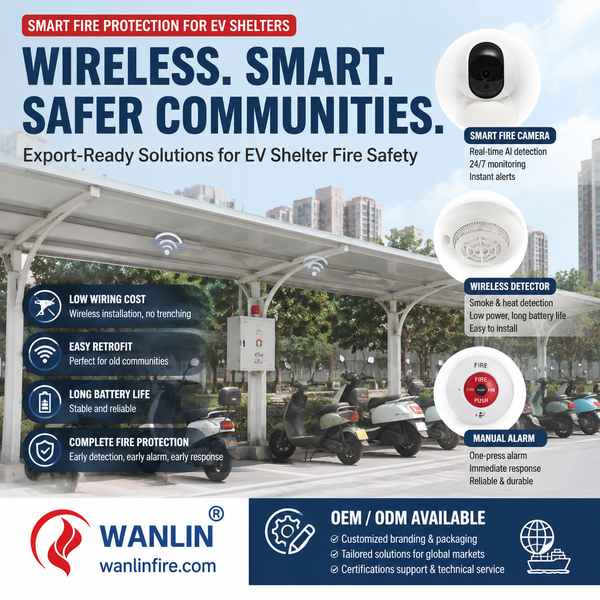
- Who it suits: fire protection distributors, suppression wholesalers, charging site operators, property and facility managers, system integrators, contractors and tender based project buyers in Spain
- Reference standard: suppression upgrade practice with local code submittal support, referenced to the standard in force in the destination market for battery charging areas and existing shelter fitments
- Detection principle: video flame recognition at the shelter, with the confirmed flame event driving the zone valve rather than a heat element at the nozzle
- Coverage rule: one rotary nozzle per 20 square metres of shelter floor, shown on a layout drawing issued for the project
- Factory supply band: quoted per configuration, with tiered factory pricing by order volume
- Order route: shelter survey, sample evaluation, then pallet or container consolidation with FOB, CIF or EXW terms
Case Study: Madrid Property Management Director Sourcing Success
The managing agent had been told by the residents committee to do something about overnight charging, and had no idea what the something should be.
The shelter had been built before anyone thought about what would be parked in it, which is the normal history for these structures.
The decision was made on the audit question rather than on the fire question: which option could hand over a signed test record. Sarah Whitfield signed off the first Fire Ball Replacement Program for E-Bike Shelters order covering 17 shelter sites in Spain, and the specification was rebuilt around detection logic, coverage and the measured water supply rather than around a brand name.
A 18 day trial on one bay block settled the detection question faster than every email exchange before it. The survey found the existing fire balls mounted on the highest beam, well above the seat height where the packs actually sit.
Problem Analysis & Field Report: Why Buyers in Spain Need Fire Ball Replacement Program for E-Bike Shelters
The uncomfortable part of this category is that the equipment most commonly installed in these shelters is designed to wait.
A fire ball functions when flame reaches it. That is the whole design, and it is why a fire starting under a seat can finish a shelter untouched by the device above it.
Field case: A shelter in Madrid lost eleven scooters while three fire balls above the fire stood intact, one of them three metres away.
- Powder does not remove heat from a pack, which is why cooling is the missing half
- One to two metre coverage leaves gaps in a shelter, and the gaps are where the fire walks
- Contact activation means the fire has to reach the device before anything happens
- Expired agent is a common audit finding, and the device looks fine from the ground
Why Fire Balls and Manual Response Fall Short in E-Bike Shelters
A hanging fire ball is popular in two-wheeler shelters because it is cheap and it needs no design. It functions when flame reaches the sphere. That single condition is the problem, because a lithium pack fails at seat height under a seat, and the fire has to travel to the device before anything happens. A shelter fire does not wait for that trip.
- Activation: the fire must reach the ball, so a pack fire under a seat can be well advanced before the device responds, and a ball above the fire can survive the event intact
- Coverage: a one to two metre protection radius means several devices per shelter, with dry gaps between them where the fire walks from bay to bay
- Cooling: dry powder knocks down visible flame and removes little heat from a pack, so re-ignition after discharge is common
- Duration: it is a one shot device. Once it has discharged there is nothing left for the second ignition, and lithium packs do come back
- Manual response: an extinguisher needs someone present, awake and willing to approach a battery fire, while overnight charging happens with nobody there at all
- Comparison in one line: a fire ball waits for the fire to come to it; a detection driven system looks for the fire and then keeps water on it for as long as the supply lasts
We sell water based systems, so we have an interest in this comparison and we state it plainly. The honest argument is not that powder does nothing. It is that a one shot device with no cooling and a short reach does not fit a fire that propagates along a row of fuel.
How the System Works: From Flame Detection to Water on the Fire
The sequence is short on purpose, because the whole argument for automatic suppression in a shelter is that it happens before anyone can be involved.
- Detection: the flame detection camera reads flame spectral signature and shape across the charging rows, and it does not depend on a smoke layer forming under an open canopy
- Transmission: the flame event is sent to the wireless control module, so no trenching or conduit is needed between the shelter and the pump position
- Decision: the control module applies the actuation logic set at commissioning, including the delay to actuation that your consultant specifies
- Actuation: the module opens the zoned solenoid valve and starts the pump, with manual release and key switch inputs retained on the same supervised unit
- Discharge: the rotary nozzles spray the affected zone, cooling the burning pack and the vehicles next to it
- Continuation: water keeps running for the period set at commissioning, which is what addresses re-ignition rather than only flame knockdown
- Reporting: alarm, valve position, pump running and fault states are reported locally and, where the monitoring option is fitted, pushed to the operator
The delay to actuation and the run period are configuration values, not factory defaults nobody has checked. Both are stated in writing with the project drawings, and both can be set to what the local code expects.
Water Supply, Pump Sizing and Nozzle Layout for Shelters in Spain
Supply is the part of a shelter design that decides whether the layout is real. A drawing that the water cannot feed is a drawing, and the most common specification error in this category is a pump selected from the shelter floor area instead of from the nozzle count and the spray duty.
- Measure first: flow and pressure are read at the site boundary at the worst hour of the day, not at a quiet morning hour
- Mains fed route: where the measured supply meets the duty, the connection is direct, with the backflow arrangement set by the local water undertaking
- Stored route: where it does not, a tank and booster set is sized from the nozzle count, the spray duty and the run period
- Zoning: the valve is at the shelter, so one confirmed flame opens one zone, and the pump duty is calculated for the largest single zone
- Climate: freezing seasons change the tank position, the pipe route and the drainage, and those are design items rather than install details
- What we put in writing: nozzle count and spacing, pipe route, pump duty, tank volume where required, delay to actuation and run period
Shelter Suppression OEM & ODM Programs for Distributors and Trading Partners in Spain
Wanlin Fire is recruiting local partners for two-wheeler shelter protection. Our cooperation models are written for three kinds of buyer: the distributor holding stock and service in their own market, the trading company consolidating across several product lines, and the project buyer answering a performance clause on a tender. Because detection, control, valve and pump and the nozzle set ship from one factory, a partner can fill a container with a complete shelter configuration under a single bill of lading.
- Distributor and wholesaler program: Sample shelter kit available for field evaluation before commercial terms are agreed, so the detection test happens on your ground
- Private label and ODM program: After-sales technical support answering radio, valve and pump questions in writing, with the response kept in the project file
- Project and submittal support: Submittal drawings and duties issued for the local code route, so the consultant submits a design rather than a catalogue cut
- Regional partner structure: Private label housings, part numbers, packaging and manuals in the language your market expects, with label artwork handled at order stage
- Factory capability behind the offer: Detection cameras, control modules, valve and pump sets and nozzles are assembled and tested on the same lines, so a shelter kit ships as one configuration rather than as parts from four vendors
- Replacement cycle coverage: Replacement cycle coverage across detection, control, valve and pump parts, so a distributor can service a shelter years after it was installed
Partners across North America, Europe, Asia-Pacific, the Middle East, Africa and Latin America run this model today. Cross border trading companies looking for a source factory are welcome to start with a sample shelter kit and move to container volume once their own market testing is done.
Product Introduction: Fire Ball Replacement Program for E-Bike Shelters by Wanlin Fire
This is the part where a supplier either produces drawings or starts describing benefits. The Fire Ball Replacement Program is the upgrade route for shelters still carrying hanging fire balls: detection reads flame instead of waiting for it, and the discharge is sustained rather than single shot.
The shelter range covers the flame detection camera, the wireless control module, the zoned solenoid valve with the pump set or the tank and booster arrangement, the rotary nozzles, the bracket and pipe set, and the monitoring option, so one shelter is protected by one configuration rather than by parts assembled from several suppliers. Part numbers are issued per configuration and stated on the datasheet supplied with the quotation.
Technical Specifications
| Parameter | Wanlin Fire Specification |
|---|---|
| System reference | Fire Ball Replacement Program |
| Product category | Replacement and upgrade program for shelters currently fitted with hanging fire balls |
| Detection method | Video flame detection replaces contact based activation, no reliance on flame reaching the device |
| Wireless link | Wireless link to the control module, so the upgrade also removes any existing cable dependency |
| Water supply and actuation | Zoned valve and pump set with sustained discharge instead of a single short agent burst |
| Alarm and reporting behaviour | Alarm and fault supervision reported to the site and optionally to the cloud platform |
| Housing and mounting | Existing canopy used for the new detection and nozzle positions in the standard case |
| System topology | Wireless link between camera, control module and pump set, with a wired route used where the site already has conduit in place |
| Configuration and firmware | Detection zone, sensitivity band, delay to actuation and test interval set at commissioning, with firmware update path per configuration |
| Export documentation support | Technical file prepared to support local code submittals and national registration by the importer of record, including CE, UKCA, UL and FM route file sets where they apply |
| Certification documents | CE and RoHS documentation per applicable model, certificate number provided on request |
| OEM and ODM options | Logo, part number, packaging, manual languages and label artwork configurable |
| Full datasheet | Complete electrical, hydraulic and radio data provided per model on request |
| Warranty | 36-month |
Application Scenarios for Shelter Projects in Spain
| Scenario | Recommended unit | Key benefits |
|---|---|---|
| Shelter with a row of expired fire balls | Fire Ball Replacement Program | Expired agent is a common finding in audits, and the replacement makes the shelter supervised rather than decorative |
| Shelter where the balls were fitted out of reach of the bays | Fire Ball Replacement Program | Detection and nozzles are positioned to the actual parking layout instead of to the canopy beam |
| Site told by its insurer to upgrade | Fire Ball Replacement Program | Automatic detection with sustained water answers the survey point with a commissioning record |
| Portfolio standardising on one specification | Fire Ball Replacement Program | One layout rule and one spares list replace mixed devices across many shelters |
Certification, Standards and National Registration Support for Spain
Documentation decides whether a shipment clears customs and whether a consultant accepts the installation. Wanlin Fire supplies real documents for applicable models instead of a generic statement, and we recommend that every buyer verifies the certificate information for the exact configuration they intend to purchase. Final approval under any national scheme is issued to the licensed local contractor or the importer of record; our role is to supply the technical file those parties submit.
| Information | Details |
|---|---|
| Product | Fire Ball Replacement Program for E-Bike Shelters |
| System Reference | Fire Ball Replacement Program |
| Standard | suppression upgrade practice with local code submittal support, referenced to the standard in force in the destination market for battery charging areas and existing shelter fitments, CE / RoHS / REACH on applicable models, radio compliance support for wireless configurations |
| Product family routes | Fire detection and alarm standards, water based suppression and sprinkler installation standards, fire pump standards and alarm transmission standards where the device class applies |
| European and international routes | EN 54 series and EN 12259 series aligned construction papers where the device class applies, CE and CPR documentation, RoHS and REACH files, ISO 9001 and ISO 14001 manufacturing |
| North American routes | NFPA 13, NFPA 20, NFPA 72 and UL listing routes where the project names them, with FCC radio documentation for wireless configurations |
| National registration support | local code submittal support with per-configuration technical files, hydraulic calculations and national registration support for the importer of record, with UL, FM, VdS, LPCB, UKCA, SASO and SABER, SIRIM, TISI, SNI, BIS, EAC and CCCF routes where the destination names them |
| Test Reports | Detection response, valve actuation, pump duty and radio function reports available per model, with calibration records where the project asks for them |
| Certificate Number | Provided on request per model |
| Certificate Holder | Wanlin Fire or applicable certification holder |
| Certification Body | Notified body or issuing authority per certificate |
| Target Market | Spain and wider export: North America, Europe, Asia-Pacific, Middle East, Africa and Latin America |
| Importer Registration | National registration completed by the importer of record with our technical file support |
| Certificate Status | Valid for applicable models |
| Certificate Document | View and download on request |
Every export kit ships with the documentation set for the destination: declarations per model, hydraulic calculations for the issued layout, radio compliance files for the band plan in use, and labelling in the language the market expects. Final acceptance always rests with the market authority having jurisdiction, and we recommend the importer of record verifies the exact configuration before ordering.
Why Choose Wanlin Fire as Your Shelter Suppression Manufacturer for Spain
Buyers comparing suppliers in this category end up weighing the same things: whether the document matches the configuration, whether the drawings exist before the order, and whether anyone answers a pump duty question in writing.
Shelter projects add their own requirements. Parking density has grown faster than the structures were designed for, batteries are charged overnight by people who are asleep, and the sites are usually managed by whoever holds the keys rather than by a fire engineer. Buyers comparing European, North American and Japanese brands, or weighing a local trading supplier against a factory, usually end up judging the same things we are judged on: whether the drawings exist before the deposit, whether the duty is calculated from a measured supply, and whether anyone answers a pump question in writing.
| Factor | Wanlin Fire | Typical Trading Supplier | Brand Name Distributor |
|---|---|---|---|
| Manufacturing depth | Every kit is built to the layout drawing issued for the project, with the detection count and the nozzle spacing taken from the shelter plan rather than from a standard pack | Trading office, outsourced production | Brand owner, no project work |
| Document transparency | Construction and component papers supplied per configuration, with the issuing body reference stated so the buyer can check it | Family level PDF files, customs risk | Brand level only, no model files |
| Design support | Detection plan, nozzle layout and pump duty issued in writing from your drawing | Price list only, layout left to the installer | Standard package, no site layout |
| Supply realism | Pump duty calculated from a supply measured at the worst hour | Duty assumed from floor area | Fixed package, no supply check |
| Customization | Spares program sized per ten shelters, so a distributor can hold the module, the nozzle and the valve instead of waiting for a shipment | Limited to stock models | No customization, fixed SKUs |
| Price (factory direct) | Tiered factory pricing with 31% margin headroom typical for repeat partners | Low unit price, unstable sourcing | Brand markup of 2 to 4 times |
| Delivery reliability | Confirmed production slots, batch inspection photos, 25 to 40 day lead times | Unpredictable, no line access | Stock dependent, allocation risk |
| Spare parts | Spares list per ten shelters with a repeat order path | No spares program | Brand spares at brand pricing |
| After-sales | Detection sensitivity band, delay to actuation and run period set as configuration values rather than as factory defaults nobody has checked | No after-sales, high failure risk | Limited, ticket based support |
Our export programs suit fire protection distributors, suppression wholesalers, charging site operators, property and facility managers, municipal housing buyers, system integrators, MEP consultants, contractors, insurance risk surveyors and tender coordinators.
Shelter Suppression OEM Process: From Inquiry to Shipment
The sequence below is the one we hold to, because every step that gets skipped turns up later as a variation. A standard shelter project then follows 8 steps:
- Tell Us Your Target Market - the country, the code route in force and the registration scheme that applies; each market runs different certification routes, radio band plans, language sets and audit expectations
- Send the Shelter Information - plan with canopy height and column positions, parking layout, water supply at the boundary and power at the pump position
- Receive the Layout - detection positions with the aiming plan, nozzle layout with spacing, pipe route and the pump or tank duty, all stated in writing
- Verify Documentation - request the relevant CE file, EN or UL papers, hydraulic calculation and radio compliance documentation where they apply, then check the issuing body reference
- Confirm OEM Requirements - housings, logo, part numbers, languages, packaging, manuals, local language labelling and accessory sets
- Sample Evaluation - a sample shelter kit can be field tested by your technicians before commercial terms are agreed according to the agreed conditions
- Confirm Production - after specifications, commercial terms and OEM details are confirmed, the project moves into the production slot
- Shipment - goods are prepared for shipment FOB, CIF or DDP according to the agreed logistics requirements, with packing built for long sea legs
Customer Testimonials
These comments came back after the first discharge test and the first audit, which is when opinions are worth having.
- Nguyen Van Minh (Facility Management Director, New York, United States): "They measured our supply at six in the evening and changed the pump selection because of it. Nobody else had even asked what time the reading was taken."
- Ivan Petrov (Property Management Director, Stockholm, Sweden): "The part I did not expect was the fault reporting. We found a closed valve on a remote shelter before the audit found it."
- Sarah Whitfield (Property Management Director, Madrid, Spain): "Detection worked in the shelter where our smoke heads had been tripping on dust for two years, and it has not false tripped since commissioning."
Frequently Asked Questions
Q: Why replace a fire ball if it is already installed?
A: Because of how it activates. A fire ball has to be reached by flame before it functions, so a fire starting in a battery pack under a seat may grow well past the point where a ball would have helped. It is also a one shot device: once it has discharged, there is nothing left if the fire comes back, and lithium packs do come back.
Q: What is the coverage difference?
A: A fire ball is generally quoted with a protection radius of one to two metres, so a shelter needs several to approach full coverage and gaps remain between them. Our nozzle layout runs on one nozzle per 20 square metres of floor, with the spacing shown on a drawing against the actual parking bays rather than left to the installer.
Q: Does water perform better than dry powder on a battery fire?
A: Powder knocks down flame but does little to remove heat from a pack, which is why re-ignition after a powder discharge is common. Water removes heat and cools the neighbouring packs, and it can keep doing that for as long as the supply lasts. That cooling is the part that stops one scooter becoming a row of them.
Q: Can we keep the existing balls as well?
A: Many sites do during a phased upgrade, and we have no objection to it. What we would say is that mixing activation principles in one shelter makes the incident sequence harder to predict, and the audit question about who maintains what becomes muddier. Phasing by shelter is usually cleaner than mixing inside one.
Q: What does the upgrade involve in Spain?
A: Survey of the existing canopy and supply, removal or retention of the existing devices as you choose, then the detection, module, valve, pump and nozzle install with a commissioning record. We quote it shelter by shelter because the supply condition and the canopy decide the work.
Project Summary
What changed: By working directly with manufacturer Wanlin Fire, Madrid Property Management Director Sarah Whitfield gained 31% margin headroom while keeping competitive installed pricing. With verified per-model documentation, layout drawings with stated duties, suppression upgrade practice with local code submittal support, referenced to the standard in force in the destination market for battery charging areas and existing shelter fitments, detection matched to an open sided shelter, private label branding, a supply survey done before the quote and after-sales spare programs, Wanlin Fire became their long-term e-bike shelter suppression supply partner in Spain. We are a source factory actively recruiting local partners, and cross border trading companies are welcome to start with a sample shelter kit and grow into container programs.
For more information: www.wanlinfire.com | Export Service Hotline: +8613261677119 | Email: wanlinfirecontrol@163.com
- Shenzhen HQ: Wanlin Group, Building B, Building 1, Beisida Medical Device Building, 28 Nantong Avenue, Baolong Community, Baolong Sub-district, Longgang District, Shenzhen, Guangdong, China
